
Carbide vs. HSS Tooling: Which Is Right for Your Machine Shop?
Every machinist has had this conversation. You’re at the tool crib, looking at two end mills that could do the same job. One is carbide and costs $80. The other is HSS and costs $20. The carbide lasts longer, but it’s also four times the price. Which one’s actually the better buy?
The answer depends on the part you’re making, the material you’re cutting, the machine you’re running, and how much production volume is on the line. Get it right and you save money and time. Get it wrong and you’re either burning through tool budget or leaving productivity on the table. Here’s how to think about the decision.
The Quick Answer
Use carbide when: you’re running production volume, cutting harder materials, running modern CNC machines, and rigidity is on your side. Use HSS when: you’re doing setups and prototypes, working with softer materials, running older machines with less rigidity, or interrupted cuts make tool breakage a concern. Most shops keep both on hand — the question is rarely “which one” but “which one for this job.”
What Is HSS Tooling?
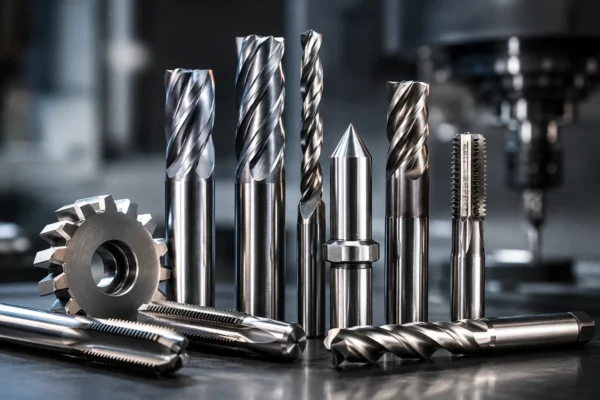
High Speed Steel (HSS) is a family of tool steels developed in the early 1900s, designed to retain hardness at the higher temperatures generated during machining. Modern HSS grades include M2 (general purpose), M35 (with cobalt for higher hardness), and M42 (high cobalt, premium grade). HSS tools are tougher and more shock-resistant than carbide, which makes them more forgiving in less-than-ideal cutting conditions.
What Is Carbide Tooling?
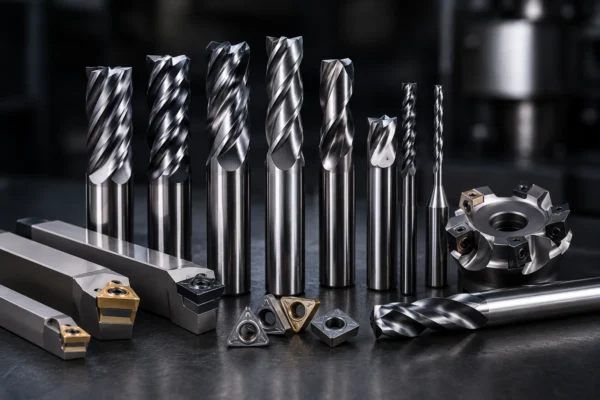
Carbide tools are made from tungsten carbide particles bonded together by a metallic binder (usually cobalt). Carbide is significantly harder than HSS — typically 2–3 times the hardness — but more brittle. Modern carbide tools are often coated (TiN, TiCN, TiAlN, AlTiN) to extend tool life, reduce friction, and handle the heat generated at high cutting speeds.
How They Compare
- Hardness. Carbide: ~90 HRA. HSS: ~65 HRC. Carbide wins by a wide margin.
- Cutting speed. Carbide can cut 3–5x faster than HSS in the same material.
- Tool life. Carbide typically lasts 10–20x longer than HSS in continuous cutting.
- Toughness / shock resistance. HSS wins. Carbide is more brittle and prone to chipping in interrupted cuts.
- Cost per tool. HSS is 3–5x cheaper than equivalent carbide tooling.
- Cost per part produced. Carbide is usually cheaper in production volume — the higher upfront cost is offset by speed and tool life.
- Forgiveness in setup. HSS handles less rigid machines, worn spindles, and chatter better than carbide.
- Sharpenability. HSS can be reground multiple times. Carbide is typically replaced rather than reground (or sent out for specialty regrinding).
When to Choose Carbide
- You’re running production volume where tool life directly affects cycle time and unit cost
- You’re cutting hardened steels, stainless, titanium, Inconel, or other tough alloys
- Your machine is rigid, modern, and capable of higher spindle speeds
- You’re running continuous cuts (no interrupted cutting)
- Surface finish requirements are tight
When to Choose HSS
- You’re doing one-off jobs, prototypes, or low-volume work
- You’re cutting softer materials — mild steel, aluminum, brass, plastics
- Your machine has limited rigidity or you’re working with older equipment
- You’re running interrupted cuts where carbide would chip
- You need an inexpensive tool for a one-time job
- You want to be able to resharpen rather than replace
Indexable Carbide: The Best of Both Worlds?
For larger tools, indexable cutting tools combine a tough steel body with replaceable carbide inserts. When an insert wears out, you rotate to a fresh cutting edge — typically two to eight edges per insert — and only replace the insert itself, not the whole tool. For most modern production machining, indexable is the standard. We carry a deep range of indexable tooling and insert grades from Kyocera and other top brands for Western Canadian machine shops.
Frequently Asked Questions
Is carbide always better than HSS?
No. Carbide is harder and faster but more brittle. For interrupted cuts, less rigid machines, or one-off jobs, HSS often outperforms carbide because it doesn’t chip as easily.
Can I run carbide tooling on an older milling machine?
You can, but you may not get the full benefit. Carbide is at its best at higher speeds and feeds than older machines can comfortably handle. On a less rigid setup, HSS or coated carbide at conservative parameters is often the better choice.
What’s the difference between coated and uncoated carbide?
Coatings (TiN, TiCN, TiAlN, AlTiN) dramatically improve heat resistance, reduce friction, and extend tool life — sometimes 2–3x or more. For most production work, coated carbide is standard. Uncoated is reserved for specific materials like aluminum where coatings can cause built-up edge.
How do I know which carbide grade to choose?
Grade selection depends on the material being cut and the operation (roughing vs. finishing). Most major manufacturers publish grade selection charts. When in doubt, our team can recommend a grade based on what you’re machining.
Can HSS tools be re-sharpened?
Yes. HSS end mills, drills, and lathe tools can typically be re-sharpened multiple times, which extends their useful life and lowers cost-per-part. Carbide can also be re-ground, but typically only by specialty regrinding shops with the right equipment.
Stocking Your Tool Crib? We Can Help.
Can-Star Industrial is a proud distributor of machine tooling for machine shops in the oil and gas industry throughout Western Canada. We carry deep inventory across carbide tooling, HSS tooling, indexable cutting tools, and the inserts, holders, and accessories that go with them — from Kyocera, Emuge, and other leading manufacturers.
Visit canstarindustrial.com to browse our catalogue or contact us for a quote on bulk and recurring orders.